

In the dynamic world of business, success often hinges on a crucial factor: the very best understanding of who exactly your customers are. Market knowledge and positioning frequently differentiate between success and stagnation for new companies, solo entrepreneurs, and micro-businesses. This guide has been developed to help you understand the principles of target markets while giving you the necessary information and resources to benefit from these target markets so that you can improve your business.
In today’s highly competitive market environment, trying to get any customer will not work in a business’s favor. Time and money are scarce commodities; for a young or a small company, they are even scarcer, so it is crucial to allocate your resources where they can do the most good. This clearly defines your target market and makes it easier for you to market your products and services to the right people who will give you repeat business.
In this guide, you will discover what target markets are, learn about their application in actual businesses, and receive guidance on how to find and appeal to your audience. Regardless of the type of venture – a tech start-up in Silicon Valley, a one-man consulting service in New York, or a small family farm in the mid-west, the information provided here can be applied to your business.
This guide will help you make the right choice to expand your business, from the basics of understanding your target market to more advanced concepts like market segmentation, from creating customer avatars to designing marketing campaigns.
Therefore, let’s start discovering and harnessing your business’s value by exploring the concept of target markets. You will learn how to identify and reach out to the customers you need for your business, whether you’re just starting or are looking to optimize your current strategy. Let’s dive in!
What is A Target Market?
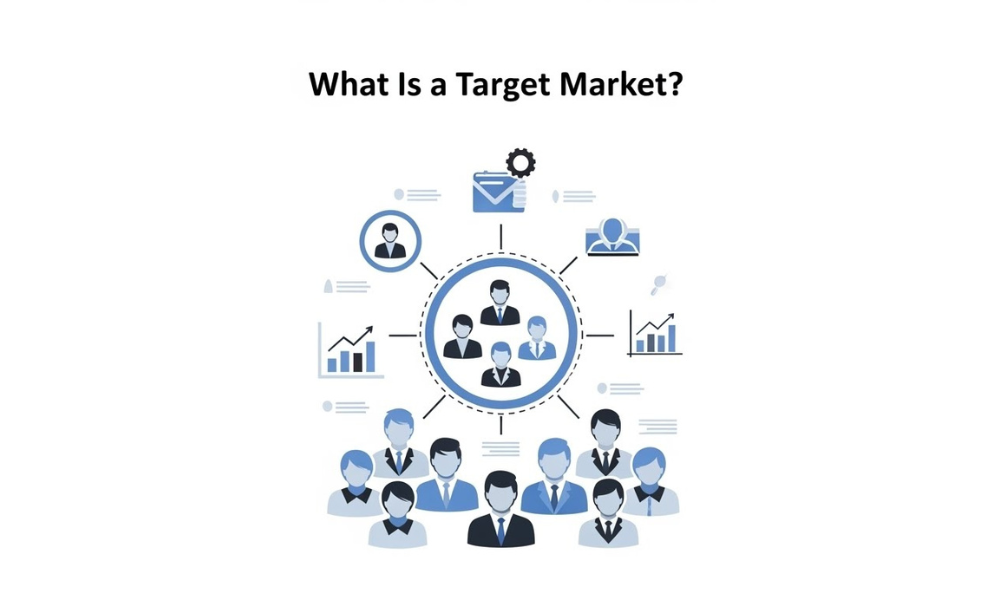
To start with, it is crucial to define what exactly is meant by the term target market. A target market refers to the specific segment of the population that a business organization will seek to satisfy through its products and services. This is the specific portion of the total population to which the seller directs its marketing communication and marketing muscle. Target market is a critical concept because it helps in the creation of appropriate marketing strategies and marketing mix.
Target markets are typically defined by various characteristics, including:
- Demographics (age, gender, income, education level)
- Psychographics (lifestyle, values, interests)
- Geographic location
- Behavioral patterns (purchasing habits, brand loyalty)
When you are familiar with your target market, you can easily design your products, services, and even marketing campaigns in order to capture their interests and thus make your business endeavors productive.
Why Target Markets Are Important For Your Business
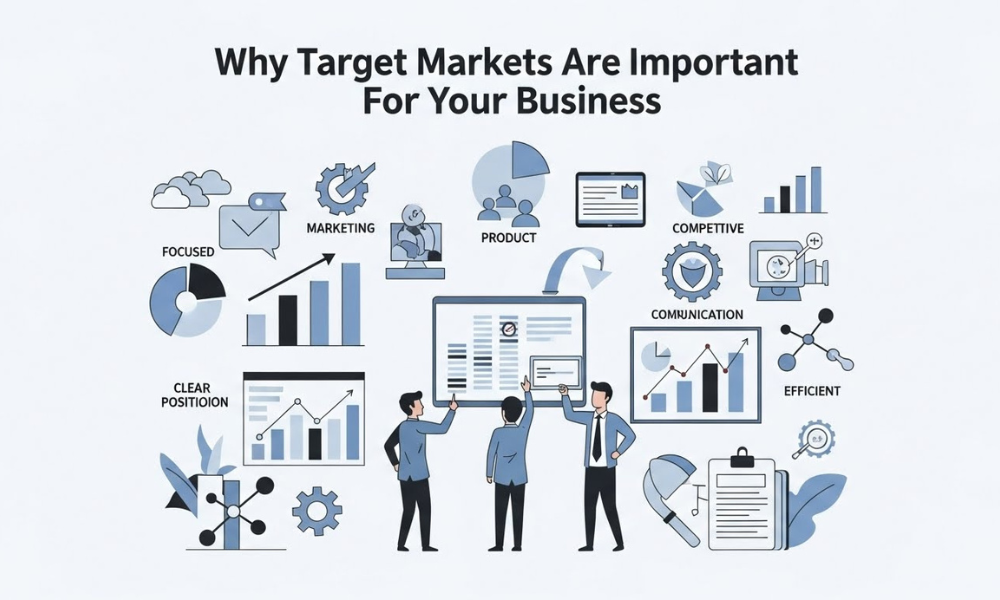
Focused Marketing Efforts
Market segmentation makes it easier for firms to allocate their marketing efforts to the segment most likely to buy their product or service. This approach of focusing on specific target markets creates more value for your marketing dollar and, thus a higher ROAI. When you have a proper demographic of your target audience, your marketing campaigns are more accurate, thus avoiding a complete waste of resources and ensuring more of your campaigns are effective, leading to more sales and optimized use of the budget.
Improved Product Development
Knowing the target market enables one to come up with products or services that are most likely to meet the needs or requirements of the users. It results in a higher satisfaction rate and, therefore can increase the level of customer loyalty. In this way, you establish strategies that are in sync with your client’s needs, and this leads to the development of more distinct products and services, embracing the loyalty of a happy customer base.
Enhanced Communication
This knowledge helps in delivering better marketing messages to the intended audience as compared to when you have no idea who your target market is. It allows you to speak the clients’ language, focus on the issues that affect them most and emphasize the most relevant value propositions. Such an alignment in communication helps develop trust and interest towards the marketing messages, making your marketing messages more convincing and interesting, therefore resulting in a better customer relationship and conversion.
Competitive Advantage
The concept of the target market ensures that owners and managers understand where they stand in relation to the competition. When choosing a niche or a target group, one becomes a specialist, and people start to turn to that individual as an expert. It enables one to provide propositions and solutions that are not easily copied by commodity competitors, therefore positioning the brand as the authority in the given segment and building a loyal clientele who value the specialized solutions delivered by the brand.
Better Resource Allocation
Market knowledge enables you to be wise in resource distribution in every area affecting your business, such as production and customer care. This way, you will know where to direct effort, time, and money so that you can aim towards projects that will affect your major consumers and where you get the maximum results for your bucks, minimizing wastage and ineffectiveness.
Increased Customer Satisfaction
This helps in meeting and even surpassing customers’ expectations, thus increasing satisfaction levels and resulting in positive recommendations. This means that customers are more likely to stick to your business and even recommend others to patronize it, a cycle that is beneficial to your business in the long run and helps to boost your reputation.
Higher Conversion Rates
If your marketing is targeted at the right audience, you will get qualified leads, which ultimately translates to high conversion rates and overall sales. When you target prospects who are interested in your offerings, you leave out many uninterested parties, thus making the change of turning them into customers easier, making your sale cycle more efficient, and thus increasing your profitability.
Long-term Business Growth
Knowledge of your target market makes it easier to manage your business with respect to customer needs and wants. Such foresight means that your product is still needed and relevant in the market, and you are able to create a stable base for continued growth. By continually meeting and anticipating market demands, you position your business for sustainable success and resilience in a dynamic marketplace.
Target Market Examples
Let’s explore 12 target market examples to illustrate how different businesses define and cater to their specific audiences:
1. Target market restaurant
A high-end Italian restaurant in a metropolitan area might target:
- Age: 30-55 years old
- Income: Upper-middle to high income
- Interests: Fine dining, wine enthusiasts, food connoisseurs
- Behaviour: Frequent diners who value quality ingredients and authentic cuisine
2. Target market McDonald’s
McDonald’s caters to a broad audience but focuses on:
- Families with children
- Young adults and teenagers
- Budget-conscious consumers
- People seeking quick, convenient meals
3. Target market Coca-Cola
Coca-Cola’s target market is quite broad, but they often focus on:
- Age: 12-50 years old
- Lifestyle: Social, active individuals
- Psychographics: People who value happiness, togetherness, and refreshment
4. Nike’s target market
Nike targets:
- Age: 15-40 years old
- Interests: Sports enthusiasts, fitness-conscious individuals
- Lifestyle: Active, health-oriented people
- Psychographics: Competitive, achievement-oriented individuals
5. L’Oreal target market
L’Oreal’s target market varies by product line but generally includes:
- Gender: Primarily women, with some men’s product lines
- Age: 20-60 years old
- Income: Middle to upper-middle class
- Interests: Beauty, skincare, personal grooming
6. Target market for Starbucks
Starbucks focuses on:
- Age: 22-60 years old
- Income: Middle to upper-middle class
- Lifestyle: Urban professionals, students
- Psychographics: Coffee enthusiasts, those who value quality and experience
7. T-Mobile Target Market
T-Mobile targets:
- Age: 18-45 years old
- Income: Middle-class
- Behaviour: Tech-savvy consumers
- Psychographics: Value-conscious individuals seeking flexible plans and good customer service
8. Target market of Walmart
Walmart caters to:
- Income: Low to middle-income households
- Demographics: Families, budget-conscious shoppers
- Geographic: Suburban and rural areas
- Behaviour: Price-sensitive consumers looking for everyday low prices
9. Target market for Apple
Apple’s target market includes:
- Income: Middle to high-income individuals
- Age: 20-45 years old
- Psychographics: Tech enthusiasts, creatives, professionals
- Behaviour: Early adopters, brand-loyal consumers
10. Target market real estate
A luxury real estate agency might target:
- Age: 35-65 years old
- Income: High net-worth individuals
- Lifestyle: Successful professionals, business owners
- Interests: Luxury living, investment properties
11. Target market for energy drinks
Energy drink brands often target:
- Age: 18-35 years old
- Lifestyle: Active, busy individuals
- Occupations: Students, athletes, and professionals with demanding schedules
- Psychographics: Those seeking increased energy and mental alertness
12. Target market hotel
A business-focused hotel chain might target:
- Age: 30-60 years old
- Occupation: Business travellers, corporate executives
- Behaviour: Frequent travellers who value comfort and convenience
- Psychographics: Those who appreciate loyalty programs and consistent experiences
These examples demonstrate how diverse target markets can be and how businesses tailor their offerings to meet the specific needs and preferences of their chosen audience.

Target Market vs. Target Audience
While often used interchangeably, target market and target audience have subtle differences that are important to understand:
Target Market
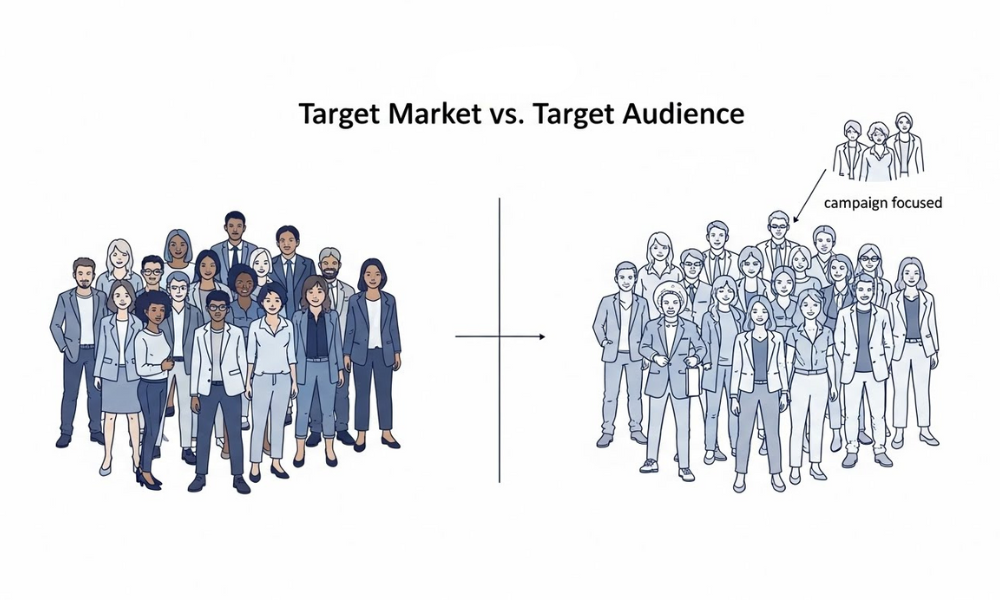
The target market is a more general concept that refers to the whole population of consumers who may buy your offering. This group is determined by factors such as age, sex, income, education, geographical location, interests, values and lifestyle. Market understanding is important for the overall business and product strategy because it defines who your potential customers are and what they require. Thus, understanding these characteristics will help you align your products or services to their expectations and needs, thus making your offerings desirable. This approach enables you to strategically place your brand in the market, achieve competitive advantage, and develop value propositions that will appeal to the market.
Target Audience
The target market, on the other hand, is a broader category of consumers within which the target audience is located. It means the specific group of people you are targeting with a specific marketing message or campaign. This subset can be identified based on finer characteristics such as behavioural patterns, purchasing frequency, or interests that are directly related to the campaign in question. The target audience is employed in creating extremely specific marketing messages and identifying the right channels through which to reach the audience.
By focusing on this audience, it is possible to develop relevant and interesting content that addresses the target audience’s needs and wants. This precision in targeting increases the effectiveness of your marketing campaigns, customer satisfaction, and subsequent conversion rates. Demographics and segmentation of the target market are critical for the effectiveness of specific marketing activities and guarantee that all available resources will be used to achieve the planned goals.
For example, a clothing retailer’s target market might be women aged 18-35 with middle to high income. However, for a specific summer dress campaign, their target audience might be women aged 22-28 who are planning beach vacations.
Understanding this distinction helps businesses create more effective marketing strategies and tailor their messaging appropriately.
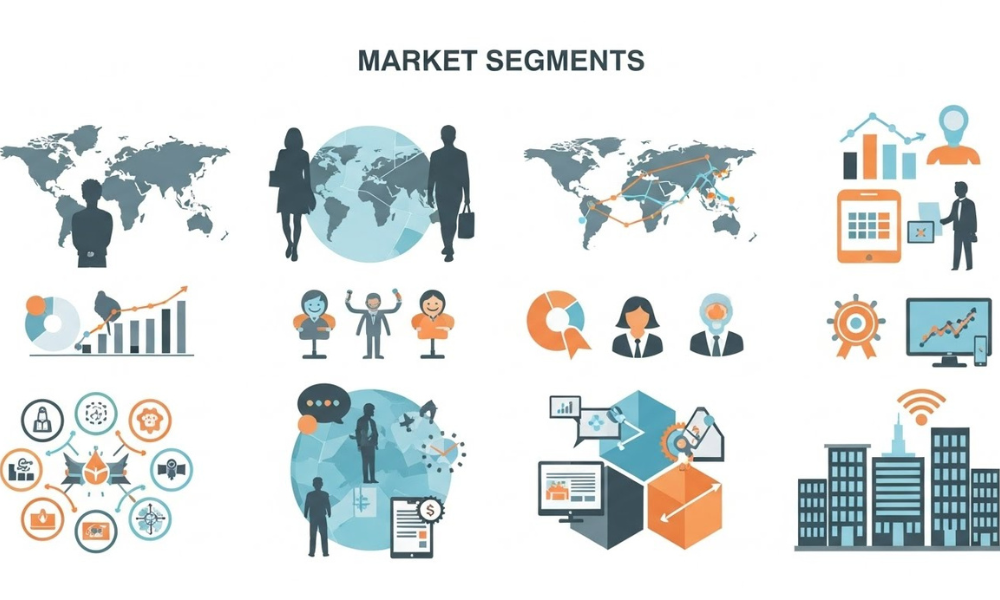
What Are the Market Segments
Market segmentation is a strategy where the large and broad market of consumers or businesses is split into smaller groups of consumers based on certain similarities that they share. This is important since it helps companies to focus on different groups and make appropriate marketing investments.
There are several types of market segmentation:
1. Demographic Segmentation
This involves dividing the market based on variables such as:
- Age
- Gender
- Income
- Education level
- Occupation
- Family size
- Religion
- Race
- Nationality
Example: An example of demographic targeting might be a luxury skincare line marketing to women 30-50 years of age with disposable income and college-educated. These women are working and have career or managerial jobs and are in search of quality and high-performing anti-aging treatments. The brand could also niche down even more and target only urban women because a number of them are busy working women who have high disposable income and are willing to spend on brands that offer the best skincare solutions.
2. Behavioral Segmentation
This focuses on consumer behaviour patterns, including:
- Purchasing habits
- Brand loyalty
- Product usage rate
- Benefits sought
- Readiness to buy
Example: A fitness apparel company may choose to make market segments based on the purchase behaviour and needs met. For example, they could focus on subjects who are physically active and often buy sportswear clothes because they are looking for high-quality, long-lasting, and fashionable garments. They might segment further within this criteria, classifying customers as brand loyalists as well as those who are value-conscious or interested in the latest trends in fitness equipment. With such behavioural patterns understood, the company can create its promotional campaigns with the aim of encouraging multiple buying, rewarding loyalty, and drawing attention to certain product attributes of every subgroup.
3. Psychographic Segmentation
This method divides the market based on:
- Lifestyle
- Personality traits
- Values
- Attitudes
- Interests
- Opinions
Example: A travel agency that focuses on adventure tourism may wish to market its services to consumers whose lifestyle is more on the active outdoor kind. It will be appealing to these consumers’ experiences, as opposed to the accumulation of tangible goods; they are likely to consider the thrill and adventure of products as crucial and they are environmentally conscious. These may include trekking, camping, and nature-related tourism interests. Regarding these psychographic factors, the travel agency can develop marketing strategies that focus on aspects such as the adventurous nature of their travel packages, the uniqueness of their travel packages and their responsible approach to tourists and the environment, which will meet the interests and values of their target audience.
4. Geographic Segmentation
This involves dividing the market based on:
- Country
- Region
- City
- Climate
- Population density
- Urban/rural areas
Example: A coastal tourism organization could target the densely populated areas of the large cities in the interior of the country. Thus, by focusing on cities like Denver, Colorado or Dallas, Texas, in which people are likely to look for beach destinations the company can reach a vast audience interested in coastal locations. The marketing strategies could focus on the accessibility of the destinations, the picturesque sea views, and the kinds of attractions that may be available, like beach hotels and water sports, seafood and sunshine for people who may be tired of their terrain.
5. Firmographic Segmentation
Used primarily in B2B marketing, this method segments based on:
- Company size
- Industry type
- Number of employees
- Annual revenue
- Location of headquarters
Example: An example of a niche audience for a cloud storage solutions provider would be mid-sized technology companies with 50-200 employees and revenues between $5 million and $50 million. Many of these firms are situated in technology hotbeds such as Silicon Valley or Austin, Texas, and hence experience the need to store increasing volumes of data in a manner that is easily expandable. Thus, the provider will be able to target this segment and address the concerns of tech companies, including data security, methods of organizing storage, and compatibility with existing IT systems, as the product becomes a necessity for business development in the technology sector.
6. Technographic Segmentation
This newer form of segmentation focuses on the following:
- Technology usage
- Adoption of specific tools or platforms
- Tech proficiency levels
Example: A cybersecurity firm might divide its market according to how protected a business is at the moment and how keen it is on implementing improved protection measures. For instance, the firm could aim at organizations that are in the cloud computing business and those who are interested in adopting new technologies to secure their information. These firms have complex IT infrastructures and high-tech literacy and would be good targets for enhanced cybersecurity. In this way, the cybersecurity firm can determine exactly which technologies and platforms the businesses it wants to attract use and then offer those firms solutions that can be easily integrated into their existing IT environments to solve their particular security issues and improve their overall defensive capabilities.
With knowledge of these various segmentation types, businesses can devise a perfect marketing strategy that is appealing to the market’s targeted audience.
How to Identify and Define Your Target Market
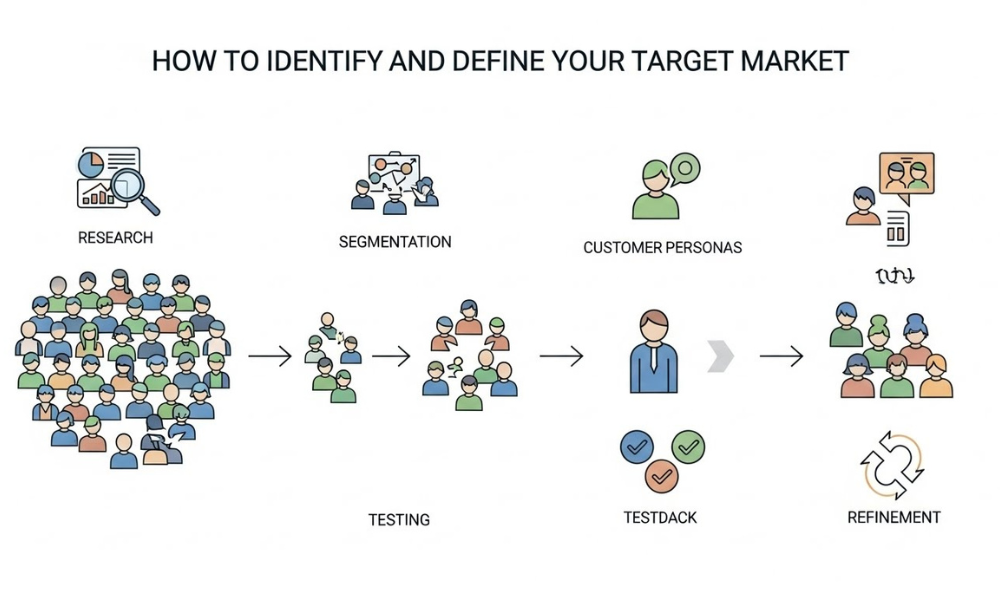
Identifying and defining your target market is a crucial step in developing your business strategy. Here’s a step-by-step guide to help you through this process:
1. Research Your Market
- Analyze your product or service: This paper argues that the key problem that CGIAR addresses is the fulsome funding of the Global Public Good Innovation System. What are the incidences where this advantage is applicable?
- Study your current customer base: To whom do you supply your best brands? The elements of commonality between them include: The elements of commonality between them include:
- Investigate your competition. Who are they targeting? Are there any untouched groups of consumers that the competitors still need to address?
- Conduct market research: Use convenient samples, questionnaires, focus groups, and other published materials to gather information on the target consumers.
2. Segment Your Market
On the basis of your analysis, divide the target market into the different types of segment variables that include the following;
- Demographic
- Behavioural
- Psychographic
- Geographic
In your mind, consider which category of customers will be the most appropriate for your offer.
3. Set Your Target Customers
Evaluate the relevancy of each market segment and define the ones that most closely correspond to the business objectives and capabilities.
Consider factors such as:
- Market segment size and its growth rate
- Competition within the segment
- This is the extent to which you can captivate customers, understand their needs and respond adequately to them.
- The criteria that determine the choice of segment should, to some degree, take into account the brand values and mission statement.
4. Create Customer Personas
Develop specific and distinct pictures of the chosen target market that include the desired consumers. Include information such as:
- Age, gender, income level, and educational level.
- Psychographics (interests, values, lifestyle)
- Purchase behaviours (purchasing behaviours, brand loyalty)
- Pain points and challenges
- Goals and aspirations
5. Validate Your Target Market
Test your assumptions by:
- Conducting further market research
- Running small-scale marketing campaigns
- Gathering feedback from potential customers
6. Refine and Adapt
Remember that, throughout the project work, you will be accumulating more knowledge and experience which results in changing your target market. The target customer of a business needs to change with market trends, and for that, markets must always be changing.
How To Write A Target Market Profile?
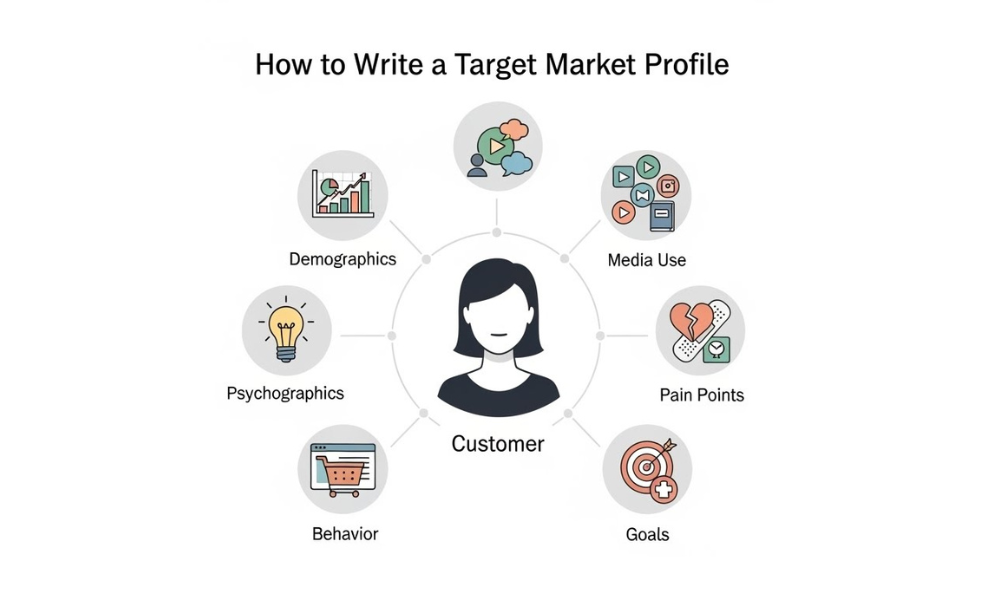
A target market profile, therefore, refers to a scenario that unveils who the firm would desire to sell its products to. Compared to basic customer information, it contains broad information about a customer and his or her needs and how your product or service can meet those needs.
Here’s how to create an effective target market profile:
- Start with Demographics: This may include the users’ age, gender, income, level of education, occupation, and marital status, among other things.
- Add Psychographic Details: Describe their pattern of living, beliefs, hobbies, beliefs and perceptions in that order.
- Include Behavioral Information: Further explain their buying behaviour, their chosen brands as well as products and their usage of the products and the decision making process.
- Identify Pain Points: What problem or want in life can your target market relate to which your product or service offers a solution?
- Describe Goals and Aspirations: What problems or goals is your target customers trying to solve or achieve? How does your offering enable the consumer to solve the problem that they already have?
- Detail Media Consumption Habits: That questionable revenue source raises another question: Where do they get their information from? Whose social media platforms are they active? The third research question is: Who are their target markets?
- Include Quotes or Statements: Post actual or fictional words that a person of the target client’s demographic would use.
- Create a Visual Representation: Consider creating an avatar or looking for a picture on the Internet that shows your ICP (Ideal Customer Profile).
Target Market Profile Example
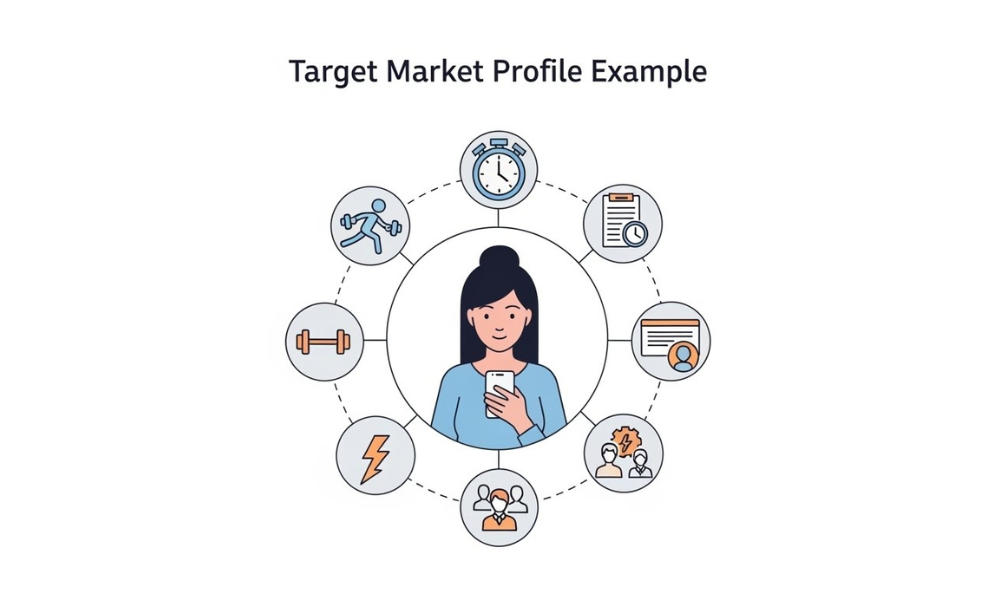
Here’s an example of a target market profile for a hypothetical fitness app:
Name: Sarah, the Busy Professional
Demographics:
- Age: 32
- Gender: Female
- Income: $75,000/year
- Education: Bachelor’s degree
- Occupation: Marketing Manager
- Marital Status: Single
Psychographics:
- Values health and wellness but struggles to find time for it
- Ambitious and career-driven
- Enjoys social activities and trying new experiences
- Tech-savvy and always connected
Behavior:
- Uses smartphone apps for various aspects of life (banking, social media, food delivery)
- Prefers quick, efficient workouts
- Shops for workout clothes and gear online
- Follows fitness influencers on Instagram
Pain Points:
- Finds it challenging to maintain a consistent workout routine due to busy schedule
- Feels intimidated by traditional gyms
- Wants personalized guidance but can’t afford a personal trainer
Goals:
- Improve overall fitness and energy levels
- Reduce stress and improve work-life balance
- Feel more confident in her appearance
Quote: “I know I should work out more, but between my job and social life, I can never seem to find the time or motivation. I need something that can fit into my busy schedule and keep me accountable.”
Media Consumption:
- Active on Instagram and LinkedIn
- Listens to podcasts during the commute
- Reads fitness and lifestyle blogs
This profile provides clear insight about the target customer, which the fitness app company can use to influence the app’s features, marketing message, and overall approach to the market with a view to capturing Sarah’s market.
What Is Target Market Analysis?
Target market analysis involves defining prospects and evaluating them to check the feasibility and profitability of the product or service to be offered on the market. This analysis assists you in comprehending your customers’ wants, tastes, and actions and thus makes the right business decisions.
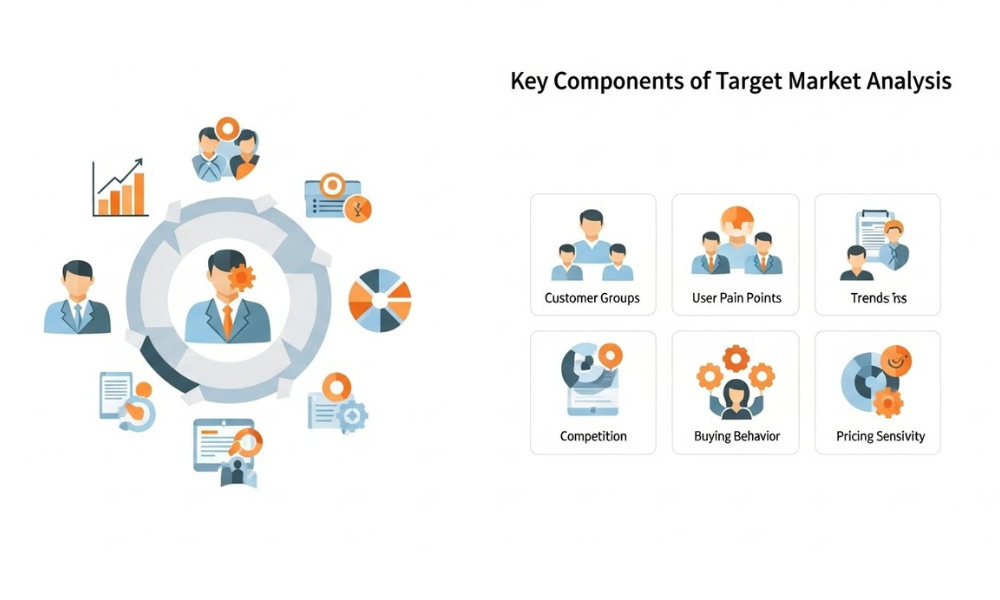
Key Components of Target Market Analysis
- Market Size and Growth: Identify the size of the target market and the growth opportunities that can be expected in that specific market.
- Market Segmentation: Your market can be segmented based on the similarities that a group of customers may have.
- Customer Needs and Pain Points: It is essential to understand what precise issues your product or service will solve for your target audience.
- Competitor Analysis: Consider their advantages and disadvantages, and their position in the market.
- Market Trends: Identify current and future trends that could influence the conduct or requirements of your target market.
- Buying Patterns: Know the buying processes, times and motives of the target market.
- Price Sensitivity: Incorporate how the changes in price may impact the demand for your product or service.
How to Use Target Market Analysis
Once you’ve conducted your analysis, put that data to work. Here are some ways to use the information to grow and improve your business:
- Identify Niche Markets: Your analysis might reveal an underserved population. Instead of competing for the same customers as your competitors, explore these untapped markets.
- Uncover Expansion Opportunities: When evaluating your local competition, gaps in the market that are not covered can be noticed. This is useful information if the firm is thinking about franchising or opening a new outlet.
- Refine Pricing Strategy: By analyzing the competition and the price sensitivity of the target market, you can establish a good and reasonable price for your products.
- Improve Product Development: Use the analysis’s findings to improve existing offerings or create new ones that are more suitable to your target market.
- Enhance Marketing Strategies: Market your products and services and select appropriate media based on the target market consumers’ characteristics and behaviour.
- Forecast Sales: Information on the size and growth of the market should be used to create better sales forecasts.
- Identify Partnership Opportunities: Your analysis could identify some firms that may be potential strategic partners, offering products or services to similar customers.
Target market analysis is an effective way to make rational decisions concerning further activities in the chosen market.
Target Market Strategies
Target market strategy can be defined as a specific and well-thought-out plan for reaching out to your target customers. This is the process of adapting the firm’s marketing mix to the needs of the selected target market. Here are some key strategies to consider:
1. Concentrated Strategy
This strategy involves directing all marketing activities towards a particular narrow, targeted market segment. It is mainly applied by small firms or those with low capital.
Example: It is a small-scale fitness studio that focuses on prenatal yoga lessons.
2. Differentiated Strategy
This strategy is used to appeal to many market segments with appropriate marketing mixes for each segment.
Example: A clothing company that designs clothes targeting the teenagers, young working people, and those who are old enough to be considered mature adults.
3. Undifferentiated Strategy
Often called mass marketing, this strategy assumes that all market members have similar needs.
Example: An everyday cleaner for homes that can be used by any consumer, regardless of their age or gender.
4. Micromarketing Strategy
This form of targeting is very specific and aims at very small niches within the market or even at specific clients.
Example: A custom jewelry maker creating personalized pieces for individual clients.
5. Niche Marketing Strategy
This strategy entails identifying a particular and restricted market niche whose needs the business aims to meet.
Example: A pet food company specializing in organic, grain-free food for dogs with allergies.
Implementing Your Target Market Strategy
- Align Your Brand: Make sure all your branding communications are targeted to and are palatable by the target market.
- Tailor Your Product: Modify the attributes of your product or service in order to meet the needs of the chosen consumers.
- Choose Appropriate Marketing Channels: Choose the media that your target market uses and considers relevant.
- Craft Relevant Content: Develop materials that are marketing messages that would resonate well with the target market audience’s needs, wants and goals.
- Price Strategically: Your products should be priced according to the target market’s perception of value and purchasing power.
- Optimize Distribution: Ensure that the distribution channels you select are reachable and easily accessible by the targeted consumers.
- Continuously evaluate and adapt: It is highly advisable to monitor the strategy’s efficiency and be ready to make changes as the target market develops.
Target Market FAQs
Let’s address some common questions about target markets:
What is target market research?
Market research about the target market refers to the collection of data on prospective consumers with a view to establishing their wants, patterns of consumption, and similar information. This includes surveys, interviews, and focus groups, and the secondary research includes industry reports, demographic research, and competition analysis.
What are the 4 main types of target market?
The four main types of target markets are:
- Demographic (based on age, gender, income, etc.)
- Geographic (based on location)
- Psychographic (based on lifestyle, values, and personality)
- Behavioral (based on purchasing habits, brand loyalty, etc.)
What does target market size mean?
Market size, on the other hand, is the total number of customers in the segment you have identified. It is often stated as the number of user groups or families that may belong to the target market.
What are the characteristics of a target market?
Key characteristics of a target market include:
- Shared demographics (age, gender, income, etc.)
- Similar needs or pain points
- Common purchasing behaviours
- Shared values or lifestyle traits
- Geographic proximity (if relevant)
- Accessibility through specific marketing channels
What is the importance of the target market?
Understanding your target market is crucial because it:
- It helps focus your marketing efforts and budget
- Guides product development and improvement
- Increases marketing efficiency and ROI
- It helps you better meet customer needs
- It gives you a competitive advantage
- Improves customer satisfaction and loyalty
What is a target market persona?
A target market persona is a descriptive representation of your ideal customer drawn from actual market data. Demographic information is supplemented by psychographic and behavioural data so that the overall picture of the target customer helps to understand and be closer to him.
What is the target market size?
Target market size is the approximate number of consumers that one intends to sell his/her products to within the targeted market segment. It aids in determining the feasibility of the market and its demand for the product or service to be offered.
What are target market groups?
Target markets are sections of a market with specific characteristics that make up the total market. They are developed through the market segmentation process and assist you in focusing your marketing messages on certain sub-groups of your target market.
Conclusion
Market identification and market segmentation are very vital elements to the success of any business, irrespective of the size, whether it is a start-up, solopreneurial or micro-small business. The identification of target markets also helps in the proper channeling of available scarce resources since only customers with a high probability to purchase an organization’s products are targeted, resulting in improved marketing of products, development of better products in the market and, as a result, business growth.
Keep in mind that your target market evolves. However, it may be necessary to reconsider and adjust target markets as your business gets established, changes over time, and faces new competition and changing market demands. The analysis of the target market strategy should be done periodically to ensure that the business is in tune with its customers and also to avoid being overtaken by other businesses.
The concepts and strategies highlighted in this guide will prepare you to define, comprehend, and target the right customers that will benefit from your business. This will, in turn, assist you in nurturing customer relationships, boosting your sales, and creating long-term business success.


